We Audited 50 YC Startups' AI Search Visibility
We ran 50 YC companies through an AEO audit. Average AI visibility score: 34/100. Here's what's holding even AI-native startups back from AI search.

Anil Choudhary
AEO Technical Associate

Y Combinator’s Summer 2026 batch is still a few weeks from Demo Day, but the companies are already live, funded, and building in public. We ran all 50 SaaS and software companies from the batch through Flozi’s AEO audit, the same tool we use to score AI search optimization and answer engine optimization (AEO) for any site: how visible a company is to AI answer engines like ChatGPT, Perplexity, and Gemini, and how likely it is to get cited when someone asks those systems a buying question.
The average score: 34 out of 100.
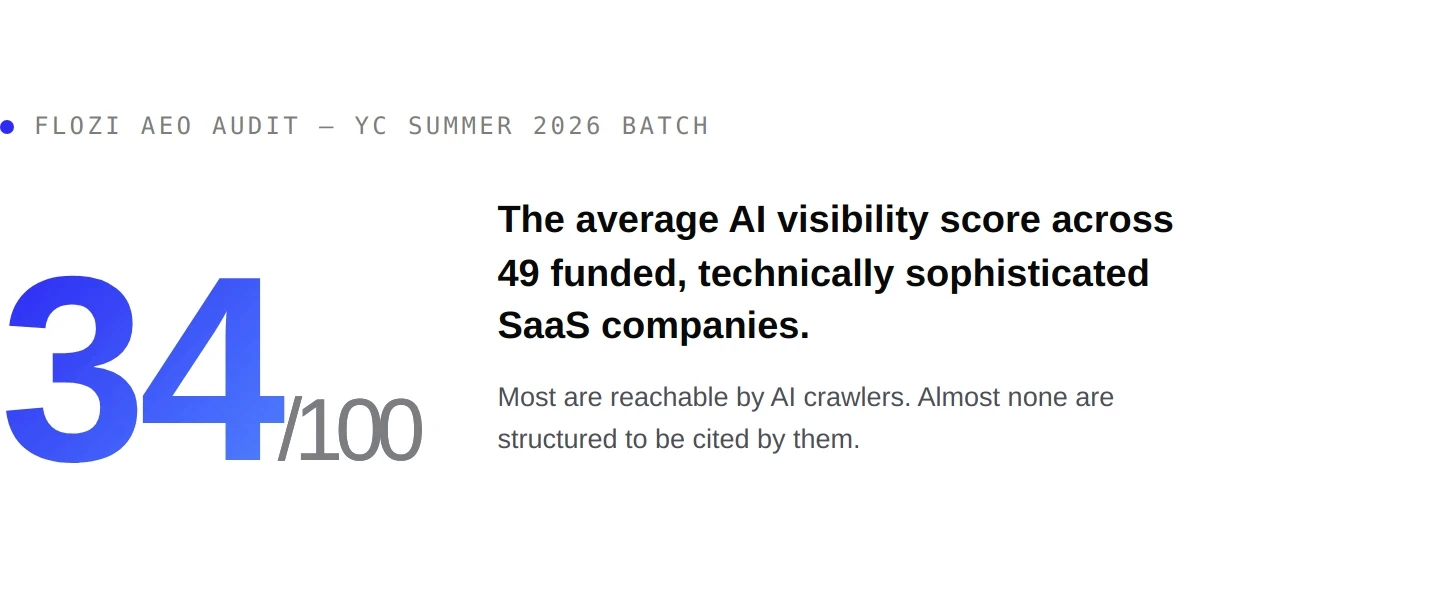
That’s a batch of some of the best-funded, most technically sophisticated early-stage teams in the world, most of them building AI products themselves, and most of them close to invisible to the AI systems their own customers use to find tools like theirs.
It’s not an access problem
The instinct is to assume low AI visibility scores come down to technical blockers: robots.txt rules, JavaScript rendering, crawlers getting turned away at the door. That’s not what the data shows here.
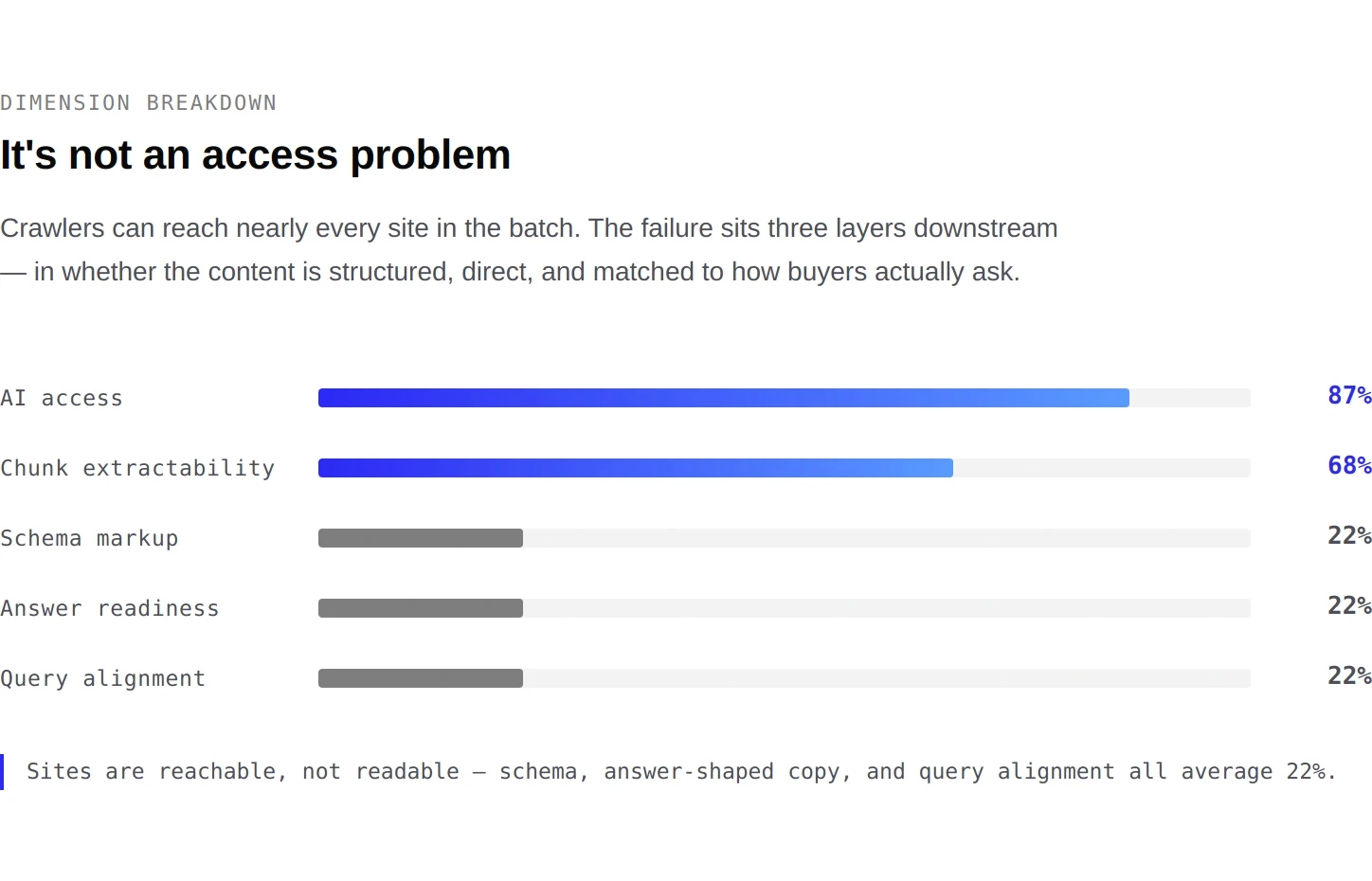
AI Access, whether crawlers can actually reach and read the site, averaged 6.1 out of 7 across the cohort, or 87%. Nearly every company passes on that front. The drop-off happens further down the pipeline, in the three dimensions that actually determine whether an LLM can extract and cite an answer:
Schema markup: 22% average. Almost nobody is using structured data to tell AI systems what their product does, who it’s for, or how it compares to alternatives.
Answer readiness: 22% average. Homepages are written for humans skimming a hero section, not for an AI system trying to extract a direct answer to “what does this company do.”
Query alignment: 22% average. When we ran real buyer-style queries against each site’s content, most companies simply weren’t retrievable for the questions their own prospects are asking, the core mechanic behind generative engine optimization (GEO) and getting cited in AI search results.
Chunk extractability, how easily AI tools can lift clean, self-contained passages from the page, was the one bright spot at 68%. The content that exists is at least well-formed. There just isn’t enough of it answering the right questions, and what’s there rarely carries the schema that helps an AI system trust it.
The full breakdown
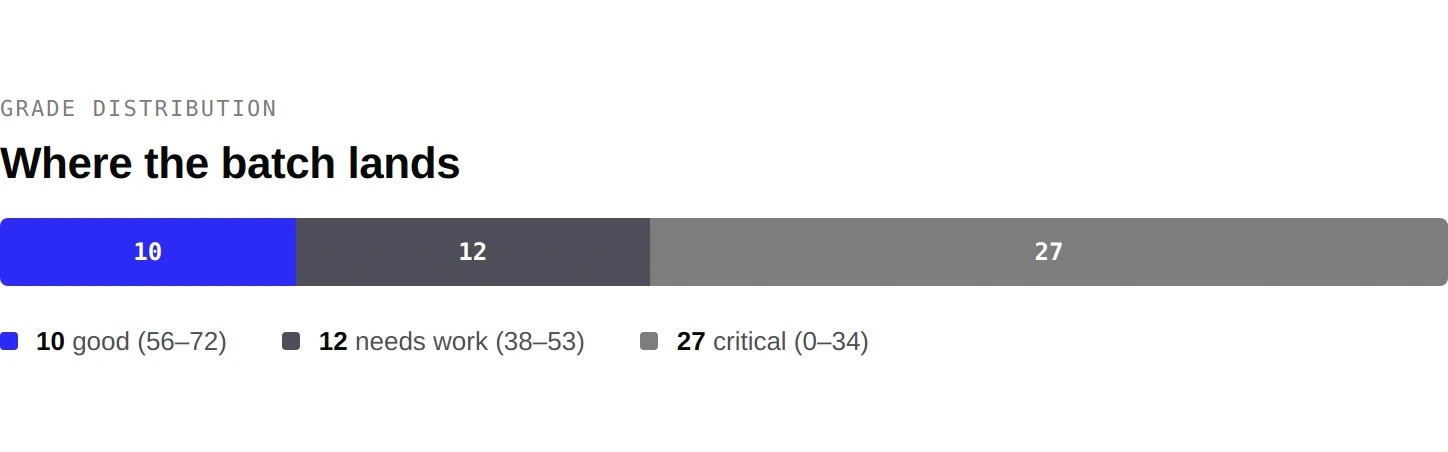
Every company below was scored on the same five dimensions and run through the same set of buyer-intent queries. Companies discussed in more detail further down are linked.
Company | What they do | Category | Score | Grade |
|---|---|---|---|---|
AI job application agent for seekers | Consumer/Recruiting | 72/100 | Good | |
Structured web data for AI agents | Infrastructure | 71/100 | Good | |
Agentic OS for e-commerce logistics | Retail/Logistics | 71/100 | Good | |
Log compression for AI incident agents | Infrastructure | 64/100 | Good | |
AI agent debit cards for single-use payments | Fintech | 63/100 | Good | |
Osmaura | Business development brain for law firms | Legal | 62/100 | Good |
Mireye | Federal-grade geospatial ground truth for AI | Infrastructure | 61/100 | Good |
Coasty | Computer-use API for browser automation | Infrastructure | 61/100 | Good |
Levocred | AI operating system for structured credit | Fintech | 56/100 | Good |
Amulet | Agentic post-sales intelligence platform | Operations | 56/100 | Good |
Vestris | AI processing unit for mortgage closing | Fintech | 53/100 | Needs Work |
AI company brain for company knowledge | B2B | 49/100 | Needs Work | |
AI-native health insurance decision graph | Healthcare | 48/100 | Needs Work | |
machine0 | Persistent AI VMs for compute-heavy workloads | Infrastructure | 47/100 | Needs Work |
Inkbox | Identity layer for AI agents | Infrastructure | 47/100 | Needs Work |
Blueprints | Autonomous prediction-market trading agents | Fintech | 45/100 | Needs Work |
Document intelligence for MEP contractors | Construction | 44/100 | Needs Work | |
Per-parcel disaster risk pricing models | Insurance/Fintech | 43/100 | Needs Work | |
Prized | AI-built internal tools from plain English | Developer Tools | 42/100 | Needs Work |
Bloomy | AI-powered K-12 mastery learning | Education | 40/100 | Needs Work |
Archal | Eval platform for autonomous software | B2B/Infrastructure | 39/100 | Needs Work |
Glen | Shared memory layer for AI agents | Productivity | 38/100 | Needs Work |
6th Sense | AI agent platform for developer workflows | Developer Tools | 34/100 | Critical |
Edviro | AI energy management for K-12 districts | B2B | 34/100 | Critical |
Ekpa | Rules-based S&P 500 trend investing | Fintech | 34/100 | Critical |
Whitespace | AI agents for wholesale distribution | Supply Chain | 33/100 | Critical |
Prescience | Health benefits platform for ambitious employers | Healthcare | 31/100 | Critical |
Shepherd | AI work memory for team tools | Productivity | 30/100 | Critical |
83 Sciences | AI-native research workspace for materials labs | Research | 30/100 | Critical |
Rex | AI order-to-cash workforce for enterprises | Finance/Accounting | 29/100 | Critical |
Poth Labs | Truth-seeking AI for customer feedback | B2B/Analytics | 29/100 | Critical |
LATO | Agent-native research for investors | B2B | 27/100 | Critical |
TalentPluto | Warm introductions for elite GTM talent | Recruiting | 27/100 | Critical |
Control Seat | AI-native layer for SCADA systems | Industrials | 24/100 | Critical |
Care GP | AI-native agent suite for GP clinics in Australia | Healthcare | 24/100 | Critical |
Operon | AI-powered manufacturing intelligence for plants | Industrials | 24/100 | Critical |
RealPact | AI agents for real estate contracts | Real Estate | 18/100 | Critical |
Perceptron ML | Event-driven real-world signal response engine | B2B | 18/100 | Critical |
Dialogus | Enterprise AI voice agents for operations | Infrastructure | 16/100 | Critical |
Verdant | AI-native permitting software for local government | Government | 16/100 | Critical |
Nebula Security | AI security research lab for code vulnerabilities | Security | 16/100 | Critical |
Denta | AI back office for dental practices | Healthcare | 4/100 | Critical |
truffle | AI-native back office for restaurants | B2B/Hospitality | 3/100 | Critical |
Petrarch | Marketplace for specialized AI training data | Data/Analytics | 3/100 | Critical |
AI-native defense supply chain layer | Defense | 2/100 | Critical | |
Quality-based pricing for AI outputs | Infrastructure | 2/100 | Critical | |
Experiential Labs | World models from agent telemetry traces | Infrastructure | 1/100 | Critical |
Markov | Harvests high-quality training data for robotics | Infrastructure | 0/100 | Critical |
Florin | Startup banking with FDIC-protected accounts | Fintech | 0/100 | Critical |
Justinian | AI government affairs firm | B2B/Legal | 0/100 | Critical |
Justinian’s domain now redirects to a rebrand, Locke. Its score reflects the stale domain rather than the live company, and it’s excluded from the analysis below for that reason.
Why the top of the list looks the way it does
Tsenta leads the batch at 72. It’s an AI job application agent, and its site does the thing almost nobody else in the batch does: it states plainly, near the top of the page, what the product is for and who uses it, backed by schema markup and a blog that answers specific questions instead of restating the tagline. That combination is most of what answer engine optimization comes down to in practice.
Context and Pango tie for second at 71. Context sells structured web data for AI agents, which means its own team clearly understands what makes content machine-readable, and it shows: full schema, strong chunk extractability, direct answers to “what does this do” and “who is this for.” Pango, an agentic OS for e-commerce logistics, gets there through content depth: enough pages, enough specificity, enough coverage of adjacent use cases that the audit’s query-matching step found real overlap with how a buyer would actually search.
Codag and Agentcard round out the top five in the low-to-mid 60s. Both are narrow, technical products (log compression for AI incident response, single-use debit cards for AI agent payments) and both write about that narrowness directly instead of hiding behind generic AI-startup language.
The middle of the pack
Most of the batch lands in the 30s and 40s, which the data says is a content and structure problem, not a fundamental one. Companies in this range typically show reasonable chunk extractability, but very little schema markup and thin answer-shaped content, real and specific products described in language too abstract for an LLM to map to a buyer’s actual question. The product is often solid. The site just isn’t built to be read by a machine yet.
A structural blind spot worth naming
A cluster of the lowest scores in the batch traces back to something more basic than content quality. Several companies are running marketing sites that render entirely in JavaScript, with no meaningful content in the initial HTML response. In our crawl, some of these homepages returned close to zero bytes of readable text on first load. To an AI crawler that doesn’t execute JavaScript, that’s an empty page, regardless of what the product actually does.
This is one of the easiest issues to miss internally, because a JavaScript-rendered site looks completely normal to a human visitor. It only becomes visible once you check what an AI crawler sees instead of what a browser renders.
Why this matters so much
We’ve seen more inquiry into SEO and AEO from our clients in the last year than at any point before. Companies that never thought about search optimization as a priority are now asking to invest real resources into it, and that shift is happening across the board, not just with AI-native startups.
Part of the reason is the bar is still this low. A batch of 50 well-funded, technically sophisticated companies averaging 34/100 means the opportunity to stand out is real and immediate. But that also means the window won’t stay open. Authority and retrievability get built over time, through consistency, not through a single well-written post. Unless a piece of content is genuinely unique or deeply useful, one blog isn’t going to earn you authority on its own. It’s a sustained effort, and it isn’t only about content and structure either, it’s about how a company shows up across the web as a whole.
Here’s the part that makes this urgent rather than optional: having a great product and a well-designed website isn’t enough anymore. Search and AI query are, without exaggeration, a company’s most important marketing channel, because nothing else converts like it.
When someone searches for what you offer or asks ChatGPT for a recommendation, they’re arriving with high purchasing intent. That’s true across the web, for nearly every kind of buyer. When a company wants to procure something, the first move is a Google search or a prompt to an AI assistant. If you don’t show up there, no other channel makes up for it.
Curious where you’d land? Run your site through the same audit, free, and see your score in minutes: flozi.io/free-aeo-audit
FREE · 60 SECONDS
Free Webflow AEO Assessment
Get your content health score across ChatGPT, Perplexity, Gemini & Claude in 60 seconds.
90+ teams have already run their assessment.
KEEP READING
Latest from the blog

SEO & AEO
How to Add WebMCP to a Webflow Form (And How to Test It)
A practical guide to adding WebMCP to a Webflow form, with the code, the origin trial setup and a testing checklist

SEO & AEO
Schema Markup & AI Citations: What Studies Show
Discover if schema markup improves AI citations and SEO rankings. Recent Ahrefs, Search Atlas & Google data reveal the truth on structured data for AEO, GEO, and search visibility in 2026

AEO as an Agency Service: How to Package, Price, and Sell
AI visibility is becoming a client conversation agencies can't avoid. Here's how to build AEO into a service you can actually deliver at scale, not just report on.
Make AI Selection a Deliberate Decision, Not a Guess
AI already knows your competitors. It just doesn’t pick you.
