The End of the Click Economy
Rankings are stable, but clicks are gone. Discover the 2-tier reality of search and how to optimize for AI visibility in the zero-click economy. Read the 2026 guide.
Search Didn't Die. It Split.
Remember when you could run a lyrics website?
In 2010, if someone wanted the words to a song, they Googled it and clicked your link. You served the lyrics, ran some ads, made a living. Simple.
By 2019, Google displayed the lyrics directly on the results page. Traffic to lyrics sites didn't dip, it evaporated. The entire niche got decapitated in under five years.
That wasn't a bug. It was a preview.
1.1 The Deal We All Forgot We Made
For two decades, the internet ran on a handshake agreement: publishers let Google crawl their content. In exchange, Google sent traffic back.
Traffic for data. Simple trade.
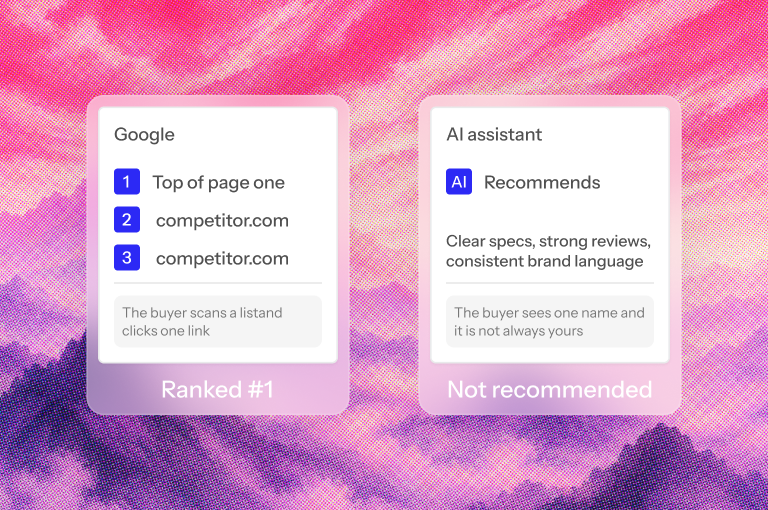
Google was a middleman, a really good one. If you wanted value from a search, you had to leave Google's ecosystem. I call this Forced Click Architecture. The search engine couldn't give you the answer. It could only point you somewhere that could.
This created predictable economics. In 2017, the distribution looked like this:
- Position 1 captured 30% of clicks
- Position 2 got 15%
- Position 3 got 10%
- Everyone else fought over crumbs
Ranking wasn't vanity. Ranking was revenue. If you held position 1 for "how to calculate CAGR," you were guaranteed a certain number of humans landing on your server every month. You could bank on it.
Then Google got ambitious.
1.2.1 When the Librarian Became the Author
The first cracks appeared between 2014 and 2020. Featured Snippets. Knowledge Panels. Google stopped being a librarian ("here are some books on that topic") and started being an author ("here's the answer").
They extracted the specific thing, the how-to step, the definition, the calculation, and displayed it right on the results page.
The result? Zero-click searches.
By 2024, over 60% of searches ended without anyone clicking anything. The user got what they needed. The publisher got nothing.
But that was just the warm-up.
In 2025, generative AI changed the game entirely. We didn't see an "update" to search. We saw a bifurcation, the moment search split into two distinct layers.
1.2.2 The Split: Two Layers, Two Different Games
Here's how I think about it now:
Layer 1: The Consumption Layer (AI)This handles commodity information. Facts. Definitions. Simple how-tos. "What time is it in Tokyo?" or "How do I boil an egg?"
There's no discovery here. Only delivery. The AI gives you the answer. You consume it. Done.
Layer 2: The Destination Layer (Human)This handles complex information. Subjective questions. High-stakes decisions. "Is this cancer symptom serious?" or "Which laptop should I buy for 3D rendering?"
Here, users distrust the AI summary. They want a primary source. A real human's opinion. Proof that someone actually tested the thing.
The tragedy? The middle disappeared.
In the old world, you could survive by being "pretty good" at providing information. Decent articles. Solid guides. Middle-of-page-one rankings.
In the bifurcated world, if your content can be summarized into bullet points by an LLM, your traffic goes to zero. The Answer Engine automated the average.
1.3 The New Interface: 80% of Your Screen, Gone
Pull up a search on your phone right now. Ask something factual.
Notice how the AI Overview takes up most of the screen? That's not an accident.
The old interface encouraged scanning and selecting. Ten blue links. You judged credibility. You made a choice. You clicked somewhere.
The new interface encourages consumption. The AI aggregates multiple sources into one paragraph and presents it as the consensus. You don't select a destination. You consume a product—manufactured by the engine using the web's data as raw material.
This creates what I call the 3-Layer Stack:
1. The Synthesis Layer (Top)The AI response. Designed to be click-sufficient. For 60-70% of informational queries, the journey ends here.
2. The Attribution Layer (Middle)Small source cards. These aren't designed to drive traffic, they're legal cover. "Look, we cited our sources." The click-through rate on these is a fraction of the old blue link.
3. The Residual Layer (Bottom)The ghosts of the old web. Pushed below the fold. Only accessed by power users who actively distrust the AI.
1.4 Why Your Dashboard Looks "Broken"
I talked to experts at Neue World in late 2025. They described the same thing: Ghost Visibility.
"We see our clients cited in Perplexity and Google's AI Overviews daily," one SEO director told me. "Brand awareness is massive. People see the name. But because the user got 90% of what they needed from the summary, sessions in Google Analytics are down 40%. The CEO thinks we're failing because the dashboard is red."
Here's the thing: the dashboard isn't lying. But it's measuring the wrong reality.
We're using session-based KPIs to measure an impression-based world.
The clicks you do get are different now. In 2018, you got random clicks, people clicking just to see if you had the answer. In 2026, you get qualified clicks, people who've already been pre-sold by the AI's synthesis and are coming for the final mile.
- Good news: These clicks convert at much higher rates.
- Bad news: There are far fewer of them.
If your business model relies on high-volume, low-intent top-of-funnel traffic, that model is obsolete.
1.5 The New Loop: Answer → Decision → Optional Click
The user journey isn't linear anymore. It's circular, and it happens mostly inside the AI interface.
Phase 1: Synthesis - User asks a question. AI provides a comprehensive answer from multiple sources. User consumes it immediately.
Phase 2: Cognitive Weighting - User evaluates: Is this enough? Can I act on this? Or do I need more proof?
Phase 3: Optional Click - If the stakes are high, medical advice, expensive purchase, legal question, the user exits to verify. They want to see a real human's name, a real company, a real customer review.
This "optional click" is the most valuable click in history. The AI already filtered for you. It's not a random visitor. It's a vetted lead.
1.6 Winner Takes Most: The Math of Disappearing
Let me show you what the middle collapse actually looks like.
Scenario: A company ranking Position 6 for a keyword with 100,000 monthly searches.
80% drop in performance. Same ranking. The floor just dropped out.
When the AI generates a response, it doesn't cite ten sources equally. It picks a primary source and two or three supporting perspectives. The winner gets the visibility. Everyone else providing similar commodity information? Ignored.
This creates a vicious cycle. The AI consistently cites the top authority. That authority gets more brand mentions. The AI learns they're the consensus. More citations follow.
The gap between #1 and #2 isn't a step anymore. It's a canyon.
1.7 The Takeaway
Search didn't die. It underwent a structural split.
We moved from a world where Google sent you to the web to a world where the engine is the web.
This creates a two-tier reality:
The Utility Tier: If you provide facts, you're a data source for the AI. Optimize for inclusion, not clicks.
The Experience Tier: If you provide trust, you're a destination for humans. Optimize for authority and the optional click.
The "broken" feeling you're experiencing? That's the friction of using old-loop tactics in a new-stack world. You're fighting for clicks that no longer exist while ignoring the answers that define your brand's future.
The question now isn't whether search has changed.
It's: what is an Answer Engine, really? And how do you win inside it?
Uncover deep insights from employee feedback using advanced natural language processing.
Get your content health score across ChatGPT, Perplexity, Gemini & Claude in 60 seconds.
Blogs
.avif)