AEO Audit Results: We Audited 69 Websites for AI Search Visibility
AEO audit of 69 websites reveals an average score of 34.3/100. See the AEO statistics, component scores, and what separates AI-search-ready websites.
TL;DR
- Average AEO score across 69 valid audits: 34.3 out of 100. Median: 34.
- AI Access passes at 88%. Query Alignment, whether a site's content actually matches what a buyer would ask an AI system, passes at just 20%.
- Zero sites scored Strong or Excellent. The best any site managed was 73.
- At the bottom of the range, a recurring pattern shows up: pages that render almost entirely in JavaScript, invisible to a crawler that doesn't execute it.
Here are the AEO statistics behind that number, and what they actually mean if you're trying to figure out where your own site lands.
How we scored this
Between June and September, we ran 75 websites through Flozi's AEO audit, our free tool for scoring AI search visibility. Each site is graded across five weighted dimensions (AI Access, Schema Markup, Chunk Extractability, Answer Readiness, and Query Alignment) and tested against 15 queries phrased the way a real buyer would ask them. Together, those five dimensions are what we mean by AI search readiness: not just whether a crawler can reach a page, but whether it can actually extract and cite an answer from it. We removed two audits from this analysis because a temporary key outage broke their Query Alignment scoring, and we deduplicated repeat submissions of the same domain down to the most recent run. That leaves 69 clean audits.
The sites themselves are not one cohort. They range from funded SaaS startups to tools we track as reference points (Webflow, Jasper, Clay) to small local service businesses. That mix is part of the point: the pattern below holds regardless of company size or category.
It is not an access problem
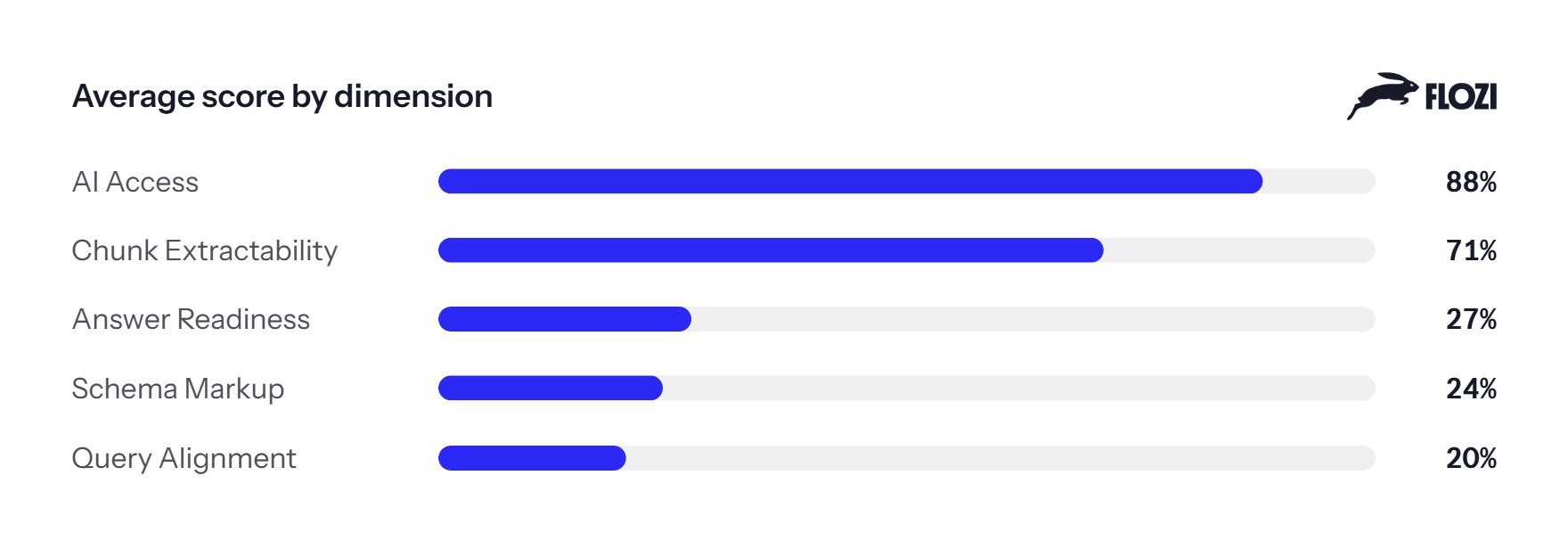
Split the score into its five components and one thing stands out immediately. AI Access, whether a crawler can reach and read the site at all, averages 88%. Almost everyone passes that check. The gap opens up after it:
Dimension | Average |
|---|---|
AI Access | 88% |
Chunk Extractability | 71% |
Answer Readiness | 27% |
Schema Markup | 24% |
Query Alignment | 20% |
Chunk Extractability, how cleanly an AI tool can lift a self-contained passage from the page, sits at 71%. The content that exists is reasonably well formed. There just is not enough of it doing the two things that matter most: telling an AI system directly what the company does (Answer Readiness), and actually covering the questions a buyer would ask (Query Alignment). Almost nothing carries schema markup either, so even the content that would qualify rarely signals its own relevance to a crawler.
What is a good AEO score?
A single average hides how wide this distribution actually is, so here is the full picture across the 69 clean audits:
Stat | Score |
|---|---|
Mean | 34.3 |
Median | 34 |
25th percentile | 18 |
75th percentile | 54 |
90th percentile | 61 |
Best Score | 73 |
Worst Score | 0 |
Based on this dataset, a good AEO score is anything above the 75th percentile, 54 or higher. Getting into the 60s (the 90th percentile) puts a site ahead of nearly everyone we've audited. Half of everything audited scores below 34. A quarter scores below 18.
Grade counts tell the same story: 38 Critical, 14 Needs Work, 17 Good, and nothing higher. Nobody in this dataset has this fully solved yet.
Why the top of the list looks the way it does
mural.co leads the dataset at 73. Its homepage says plainly what it does, it backs that up with five question-and-answer headings (exactly the format AI tools look for), and its content includes real numbers instead of vague claims. Its remaining gap is narrow: no llms.txt file, and seven of fifteen test queries still come back empty.
altrio.com (68) and frontitude.com (64) follow a similar shape to each other. Both retrieve eight of fifteen test queries, both keep their brand present in most of what gets pulled back, and both write in focused, self-contained paragraphs. Where they lose points is where almost everyone in this dataset does: neither states "we help [audience] do X" clearly enough near the top of the homepage for an AI system to summarize with confidence.
factoryfix.com (60) shows the pattern most clearly. Its content is deep and well structured, yet ten of fifteen queries return nothing, traced back to that same missing one-line description.
None of the top four have solved Query Alignment. They have solved structure. That difference is most of what separates a 60s score from a 30s score here, and it is not a matter of resources. It is a matter of not skipping the basics.
The middle of the range
jstreettech.com and dirtyboyzwastesolutions.com both land at 37, a Needs Work grade that is common in this dataset. Both show the same shape: well-formed, self-contained paragraphs (that part is not the problem), but few or zero citation-ready queries and content that never directly addresses what a buyer would search for. jstreettech.com gets zero of fifteen queries to citation-ready status. dirtyboyzwastesolutions.com gets four. In both cases, the product itself is specific and real. The site just is not written in a shape an AI system can map to a question.
This middle group is the largest single group in the dataset, and it is the easiest to fix. None of it requires touching the underlying site or product. It requires writing the content differently.
A pattern worth naming at the bottom
aurajewelry.co scores 14, and its findings point to something more basic than content quality. The site relies heavily on JavaScript to render its content, so a crawler that does not execute JavaScript sees close to nothing on first load. Everything else about its audit comes back clean, because there is barely any content for the audit to evaluate in the first place.
This is invisible to a human visitor. The page looks completely normal in a browser. It only shows up once you check what a crawler without JavaScript actually receives, and among the 69 audits here, it is a recurring pattern at the bottom of the range rather than a one-off.
Why this matters
The range in this dataset runs from funded software companies with real engineering teams down to two-page local business sites, and the average barely moves either way. That is the actual finding here: this is not a startup problem or a small business problem. It is close to universal.
A median score of 34 out of 100, with a quarter of everything audited below 18, means the bar to stand out is low, and the fix is mostly about how content is written, not what a company builds. The sites already ahead in this dataset got there with a clear one-line description and a few question-and-answer headings, not a bigger budget.
Curious where your site lands? Run the same audit, free: flozi.io/free-aeo-audit
Uncover deep insights from employee feedback using advanced natural language processing.
Blogs