Does Ranking High on Google Get You Into AI Overviews?
We pulled GSC data from four websites and manually checked 80 queries to find the correlation in Google Search ranking and AI Overview citations.
The assumption most SEO teams are working with right now is simple: rank higher, get cited more in AI Overviews. It feels logical. It's also not quite what the data shows.
We wanted to know if GSC ranking position actually predicts AI Overview citation. Not in theory. In practice, across real sites, real queries, real results. So we pulled GSC data from four websites, sampled 80 queries across position buckets, manually checked each one in incognito, and recorded what we found.
Here's what came back.
The Setup
Four sites across different categories: a SaaS tool, a design agency, a Framer templates and components site, and an AI consultancy. Three months of GSC data each. We filtered to queries with at least 10 impressions, removed branded queries, removed anything under four words, and capped at position 20. That left us with a clean pool of informational and comparison queries, the kind AI Overviews are built to answer.
We split the sample into four position buckets based on each site's average GSC position for that query: 1-3, 4-5, 6-10, and 11-20. Twenty queries per bucket, checked manually in incognito. For each query we recorded whether an AI Overview appeared, whether our page was cited, and if not, who was cited instead.
One thing to be clear about: we tracked whether our own pages, ranking in a given bucket, got cited. We were not tracking whether the overall top-ranked page for each query was cited. The finding is about your pages getting cited relative to where they rank, not a claim about what happens to whoever holds position one.
Finding 1: AI Overviews Are Appearing on Almost Everything
Of the 77 queries with complete data, 71 triggered an AI Overview. That's 92%.
This matters because most conversations about AI visibility still frame it as "will an AI Overview appear for this query." For informational and comparison queries four words or longer, the answer is almost always yes. The real question is not whether AI Overviews appear. It's whether your page gets cited when they do.
Finding 2: High Rankings Don't Guarantee Citations
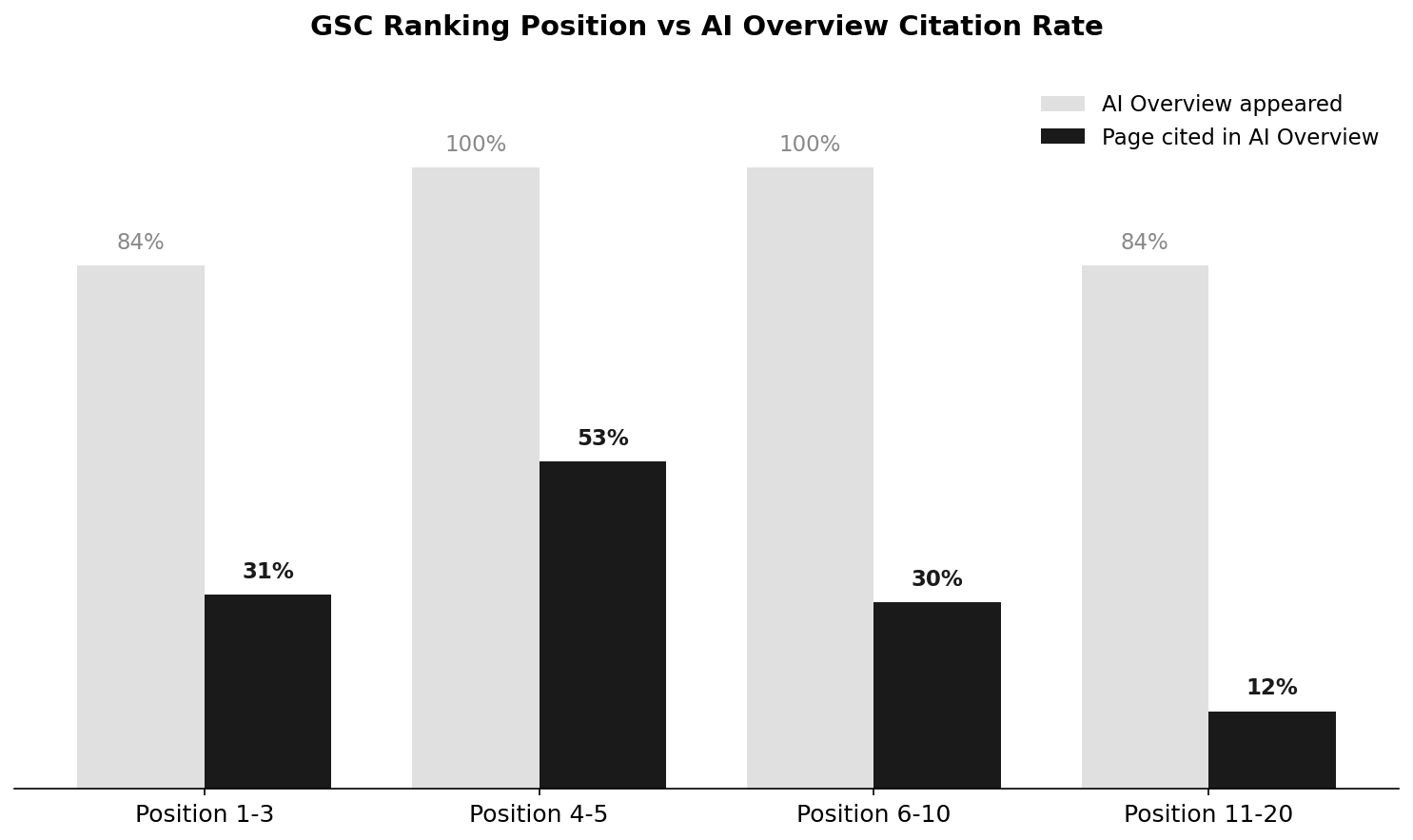
Here is the citation rate for our pages by position bucket, measured when an AI Overview appeared:
Position bucket | AI Overview appeared | Our page cited |
|---|---|---|
1-3 | 84% | 31% |
4-5 | 100% | 53% |
6-10 | 100% | 30% |
11-20 | 84% | 12% |
Even when our pages ranked in the top three positions, they were cited in AI Overviews only 31% of the time. That means for roughly seven out of ten queries where we had a strong ranking, AI found someone else's content more citation-worthy.

The drop after position 10 is steep. Pages ranking 11-20 got cited just 12% of the time, less than half the rate of top-ranked pages.
The 4-5 Bucket
Pages ranking 4-5 got cited 53% of the time, higher than pages ranking 1-3. We're cautious about over-interpreting this. It's likely a query type effect rather than evidence that ranking 4th is better than ranking 1st.
The 4-5 bucket in our sample was heavy with comparison and how-to queries: "webflow vs wordpress for enterprises", "is webflow hosting reliable for high-traffic websites", "how does webflow's hosting compare to AWS". These are exactly the query types AI Overviews are designed to answer, and the pages we had ranking there were content-heavy, structured around direct answers.
The 1-3 bucket had more navigational queries mixed in that rank well for human searchers but aren't naturally citation-friendly for AI. So the gap between the two buckets is probably as much about what kind of content ranked there as about the positions themselves.
What it does confirm: ranking position and citation rate don't have a clean linear relationship. Position matters, but it's not the only variable.
Who Is Getting Cited Instead
Across all 77 queries, the most frequently cited domains when our pages were not cited:
YouTube appeared 10 times. Official product pages appeared frequently for queries about those products. Reddit appeared twice. AI-native content sites and agency blogs appeared across multiple queries.
The YouTube finding stands out. For queries about software features, pricing, and comparisons, Google is citing video content at a meaningful rate. A well-structured tutorial video is competing directly with written pages for AI Overview citations, and in several cases winning.
Official product pages being cited for queries about those products is also worth noting. For agencies and third-party content creators writing about tools, part of the citation competition is against the source itself.
What This Means for Your Content
The data points to one clear conclusion: ranking well is necessary but not sufficient to get cited in AI Overviews.
Pages that got cited despite not holding the top position tended to share a pattern. They answered a specific question directly. They structured the answer so it appeared early in the content. They used language that matched what buyers actually search for rather than internal product terminology.
Pages that ranked well but didn't get cited were often broader, higher-authority pages covering a topic comprehensively without leading with a direct answer to the specific question the AI Overview was trying to answer.
Optimising for AI Overview citation is a different task from optimising for ranking. Ranking optimisation focuses on relevance and authority for a target query. Citation optimisation focuses on answer clarity and structure for the questions inside that query. Both matter. They require different work.
Flozi audits your site for exactly this. It shows where AI Overviews are appearing for your target queries, which of your pages are getting cited and which aren't, and what content changes would improve your citation rate. Then it helps you implement those changes directly in Webflow.
Uncover deep insights from employee feedback using advanced natural language processing.
Blogs