
AI Tracking Just Became Visible: Understanding Citations and Queries in Bing Webmaster Tools
Learn how Bing’s AI Performance dashboard tracks citations, grounding queries, and page visibility to help you understand how your website appears in AI answers.
Bing's AI Performance dashboard shows you when your website pages are cited in AI-generated answers. It tracks three key metrics: total citations (how often AI references your content), grounding queries (the phrases AI used to find your pages), and page-level citation activity. This isn't traditional analytics—it's recognition data that reveals whether AI systems consider your content reliable enough to reference, not whether users clicked on it.
Most founders working on AI visibility don’t actually lack content.
They lack feedback.
You publish pages, structure information, add FAQs, refine architecture — but there has been no clear way to see whether AI systems are recognizing your content or how they are interpreting it.
Bing’s new AI Performance dashboard introduces something different:
It shows when your pages are cited inside AI answers and which queries are used to retrieve them.
This isn’t just another analytics feature.
It’s a new layer of visibility into how AI systems interact with your website.
AI Tracking Is About Recognition, Not Traffic
The first thing to understand is what this data represents.
The dashboard tracks:
- Total citations
- Grounding queries
- Page-level citation activity
- Visibility trends over time
What it doesn’t track:
- rankings
- clicks
- placements inside answers
This means the data is not performance in the traditional sense.
It’s recognition data.
You’re seeing when AI decides your content is reliable enough to reference — not whether users clicked on it.
Total Citations: What It Actually Signals
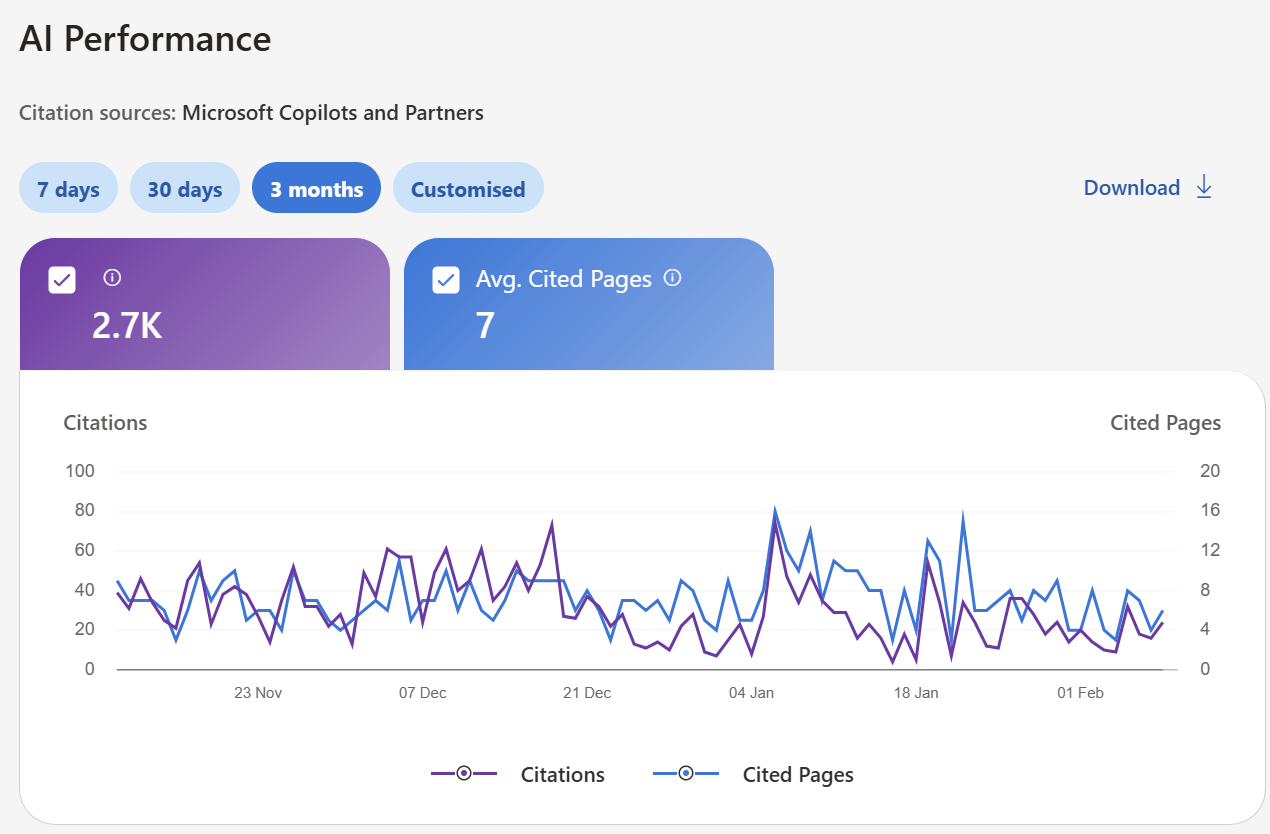
(Insert performance overview screenshot here)
Total citations measure how often your pages appear as sources in AI-generated answers.
This number is easy to misunderstand.
It doesn’t mean your content is ranked higher or shown more prominently.
Instead, it indicates:
- how frequently AI pulls information from your domain
- whether your pages are being used during answer generation
Founders should treat this as a signal of AI inclusion, not authority.
Grounding Queries: The Real Direction Indicator
Grounding queries show the phrases AI used when retrieving your content.
These are not always the same as traditional keywords.
They represent how AI systems interpret the topic and intent of your pages.
This is where the real insight lives.
When you review grounding queries, you’re essentially seeing:
- what AI believes your site is about
- which themes it associates with your content
- how your structure influences retrieval
For many founders, this becomes the first clear signal of AI direction.
Page-Level Citations Reveal Structural Signals
Another part of the dashboard shows citation counts for individual URLs.
This data answers questions like:
- Which page types are easier for AI to reference?
- Are long-form guides cited more than landing pages?
- Does clarity or depth affect citation frequency?
It’s common to see pages performing differently in AI tracking than in traditional search analytics.
That difference often reveals structural gaps rather than content problems.
Visibility Trends Show How AI Perception Changes
The timeline view shows citation activity over time.
Instead of treating this as a performance graph, think of it as an AI perception graph.
Changes in citations may reflect:
- updates that improved clarity
- restructuring that affected retrieval
- shifts in how AI connects your content to certain queries
Tracking these changes helps founders understand whether decisions are improving AI recognition.
What Founders Should Pay Attention To
Most people will open this dashboard and focus on numbers.
The more useful approach is to ask:
- Are grounding queries aligned with how I position my product?
- Are the pages I want cited actually being referenced?
- Do certain content formats get cited more often?
The goal isn’t to chase citation volume.
It’s to understand whether AI systems are interpreting your website the way you intend.
IndexNow and Why Faster Updates Matter
Bing also recommends enabling IndexNow, which notifies search engines whenever content changes.
When AI systems rely on fresh information, faster discovery can influence which version of a page gets cited.
If you’re using Webflow, you can follow this setup guide: https://www.flozi.io/blog/webflow-indexnow-setup-guide
AI Tracking Is Becoming a New Layer of Website Strategy
The biggest takeaway isn’t the metrics themselves.
It’s the fact that AI visibility is now measurable.
Citations and grounding queries give founders a new feedback loop — one that reflects how AI systems understand structure, clarity, and expertise across a site.
Showing up in AI isn’t just about adding schema or FAQs.
It requires ongoing decisions across architecture, content organization, and data consistency.
And this dashboard is one of the first tools that makes those signals visible.
Showing up in AI isn't just about adding schemas and Faqs it requires constant decisions which include site architecture, content optimizations and taking decisions on data. If you are looking for a tool which can helps your website for AI optimization give a early signup for Flozi.
Faqs
## Frequently Asked Questions
**What is the difference between citations and traditional search rankings?**
Citations measure when AI systems reference your content as a source in generated answers. Unlike rankings, citations don't indicate position or prominence—they show AI recognition and trust in your content. You're not tracking clicks or impressions, but whether AI systems consider your pages reliable enough to cite.
**What are grounding queries and why do they matter?**
Grounding queries are the phrases AI used when retrieving your content. They're not always identical to traditional keywords—they represent how AI interprets your page's topic and intent. Grounding queries reveal what AI systems believe your site is about and which themes they associate with your content.
**How often should I check my AI Performance dashboard?**
Review your dashboard weekly to track trends, especially after major content updates or site restructuring. Changes in citation patterns often lag 2-3 weeks behind updates as AI systems re-index and re-evaluate your pages.
**Do I need to enable IndexNow for AI visibility?**
While not required, IndexNow helps AI systems discover content changes faster. When AI relies on fresh information, faster discovery can influence which version of your page gets cited. It's particularly valuable for time-sensitive content.
**Why are some pages cited more than others?**
Page-level citation differences often reveal structural signals rather than content quality issues. Pages with clear structure, direct answers, and comprehensive depth tend to get cited more frequently than promotional landing pages or thin content.
**Is citation volume the most important metric?**
No. Citation alignment with your positioning is more important than volume. Ask whether grounding queries match your product positioning and whether the right pages are being referenced. Quality of citations matters more than quantity.
**Can I optimize specifically for more citations?**
Yes, but focus on clarity, depth, and structural organization rather than gaming metrics. AI systems cite content that directly answers queries, demonstrates expertise, and maintains consistency across your site architecture.
Faqs schema
{
"@context": "https://schema.org",
"@type": "HowTo",
"name": "How to Use Bing's AI Performance Dashboard",
"description": "A guide for founders on interpreting AI citations and grounding queries",
"step": [
{
"@type": "HowToStep",
"name": "Understand Total Citations",
"text": "Review total citations to measure how often your pages appear as sources in AI-generated answers. Treat this as a signal of AI inclusion, not authority."
},
{
"@type": "HowToStep",
"name": "Analyze Grounding Queries",
"text": "Review grounding queries to see what AI believes your site is about and which themes it associates with your content. Compare these to your intended positioning."
},
{
"@type": "HowToStep",
"name": "Check Page-Level Citations",
"text": "Examine which page types are cited most often. Look for patterns in long-form guides vs. landing pages to identify structural signals."
},
{
"@type": "HowToStep",
"name": "Track Visibility Trends",
"text": "Monitor citation activity over time to see if content updates or restructuring improved AI recognition."
},
{
"@type": "HowToStep",
"name": "Enable IndexNow",
"text": "Set up IndexNow to notify search engines when content changes, ensuring AI systems cite the most current version of your pages."
}
]
}
article schema
{
"@context": "https://schema.org",
"@type": "HowTo",
"name": "How to Use Bing's AI Performance Dashboard",
"description": "A guide for founders on interpreting AI citations and grounding queries",
"step": [
{
"@type": "HowToStep",
"name": "Understand Total Citations",
"text": "Review total citations to measure how often your pages appear as sources in AI-generated answers. Treat this as a signal of AI inclusion, not authority."
},
{
"@type": "HowToStep",
"name": "Analyze Grounding Queries",
"text": "Review grounding queries to see what AI believes your site is about and which themes it associates with your content. Compare these to your intended positioning."
},
{
"@type": "HowToStep",
"name": "Check Page-Level Citations",
"text": "Examine which page types are cited most often. Look for patterns in long-form guides vs. landing pages to identify structural signals."
},
{
"@type": "HowToStep",
"name": "Track Visibility Trends",
"text": "Monitor citation activity over time to see if content updates or restructuring improved AI recognition."
},
{
"@type": "HowToStep",
"name": "Enable IndexNow",
"text": "Set up IndexNow to notify search engines when content changes, ensuring AI systems cite the most current version of your pages."
}
]
}
Uncover deep insights from employee feedback using advanced natural language processing.
Uncover deep insights from employee feedback using advanced natural language processing.
.avif)
.avif)
.avif)
%20(1).jpg)
Join the Founder’s Club
$9/mo
annually
Perfect if you’re just getting started with Flozi. You get full access to the editor, SEO features, and Notion-to-Webflow sync.
.svg)