Bing’s AI Performance Dashboard: What Citation Data Webmasters Can Now See
Microsoft just launched the first AI search analytics tool. Master Bing’s 5 core AI metrics, grounding queries, and citation data to lead your AEO strategy
Updated June 2026:
Microsoft launched the first dedicated AI search analytics tool from a major search engine on February 10, 2026. The new "AI Performance" tab in Bing Webmaster Tools offers webmasters page-level citation data, AI grounding queries, and trend visualization.
This public preview represents a landmark moment for the emerging discipline of Answer Engine Optimization (AEO). It gives site owners their first systematic, first-party view into how content gets surfaced in AI-generated answers across Microsoft Copilot, Bing AI summaries, and select partner integrations.
The release puts significant competitive pressure on Google, which still merges all AI Overviews data into standard Search Console performance reports with no way to isolate AI-specific metrics.
Yet Bing's dashboard has a critical blind spot: it provides zero click-through data. Publishers can see citations but cannot determine whether AI visibility translates to actual traffic.
If you're building on Webflow and haven't connected Bing Webmaster Tools yet, we cover the full case for why it matters and how to get started: Bing Webmaster Tools for Webflow: The AI Layer.
What the AI Performance Dashboard Actually Shows
The dashboard is accessible at bing.com/webmasters/aiperformance or under the Search Performance menu. It tracks how verified site content appears across Microsoft's AI ecosystem.
The announcement explicitly frames this as "an early step toward Generative/Answer Engine Optimization tooling."
The dashboard surfaces five core metrics, all focused exclusively on citation frequency rather than traditional ranking signals:
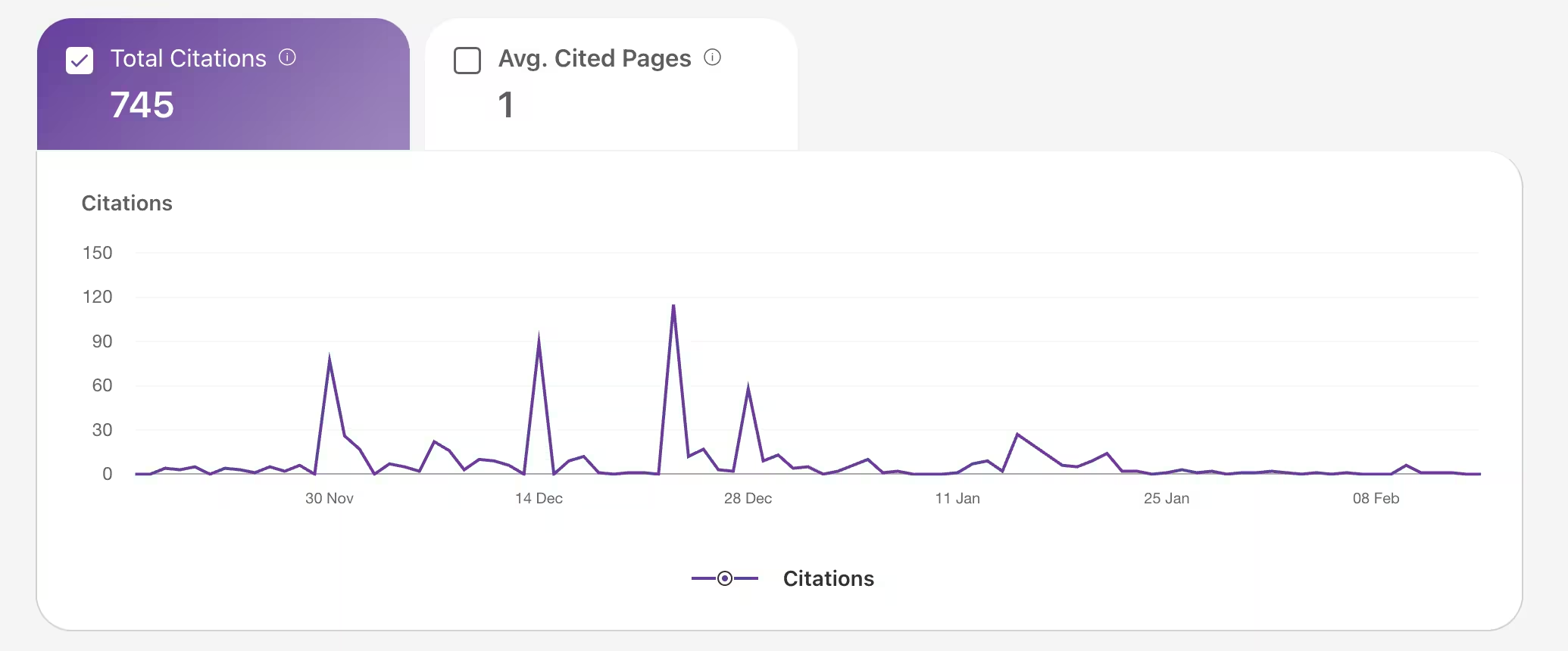
Total Citations
Total Citations counts how many times a site appears as a source in AI-generated answers during a selected timeframe. This does not indicate placement or presentation within any specific answer, only raw citation frequency.
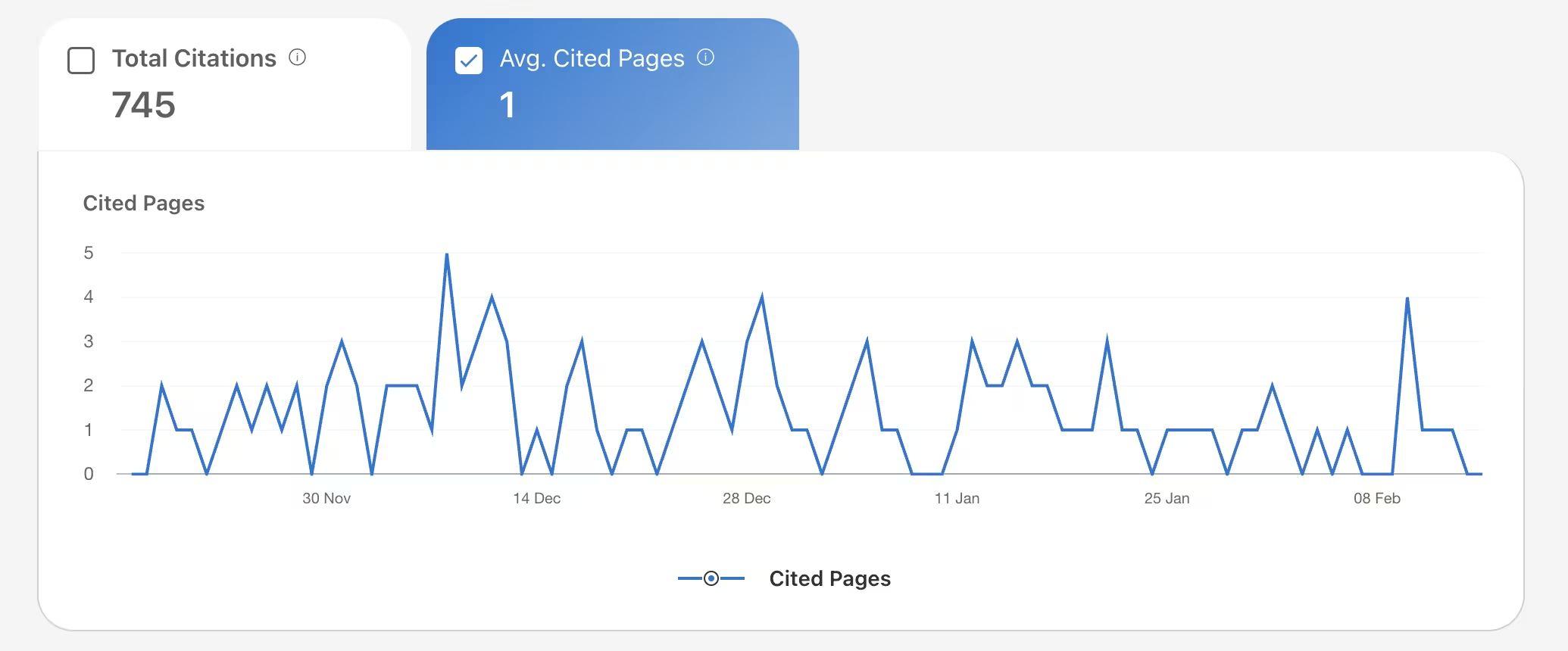
Average Cited Pages
Average Cited Pages reports the daily average of unique URLs from a site referenced in AI answers. This is aggregated across all supported AI surfaces.
Grounding Queries
Grounding Queries reveals the key phrases the AI used when retrieving content. This is a fundamentally new concept that requires careful interpretation - and may be the most consequential metric in the entire dashboard.
.avif)
Page-Level Citation Activity
Page-Level Citation Activity breaks citation counts down by individual URL, showing which specific pages get cited most often. For site owners running large CMS-driven sites (Webflow collections, for example, where hundreds of pages share a single template), this is the fastest way to identify which content formats AI systems actually prefer to cite.
.avif)
Visibility Trends Over Time
Visibility Trends Over Time provides timeline charts showing how citation activity changes across supported AI experiences. Up to three months of historical data is available at launch, which means you can already correlate structural changes you've made to shifts in AI recognition.
.avif)
June 2026 update: Bing has since added four new capabilities to the dashboard — Intents, Topics, Citation Share, and Compare — addressing some of the gaps noted at launch. Intent classification and competitive benchmarking (via Citation Share) are now available. Click-through data remains absent.
June 2026 Update: Four New Features
Bing has expanded the AI Performance dashboard with four new capabilities, now rolling out in preview globally.

Intents
Grounding queries are now classified into intent categories: Informational, Commercial, Navigational, Learn and Solve, Research, Creation, Local, and others.
This is significant. Previously, grounding queries showed you what AI was searching for when it retrieved your content. Intent classification now shows you why. A page being cited on "Informational" queries is being used to explain something. The same page cited on "Commercial" queries is being referenced during a buying decision. Those are different audiences, different contexts, and different content requirements.
For Webflow sites, this gives you the first direct signal about whether your content is reaching buyers or researchers — and whether the citations you're accumulating are from the part of the funnel that matters for your business.
Topics
Related grounding queries are now grouped into thematic clusters, showing visibility across broader subject areas rather than individual query strings.
This maps closer to how AI systems actually organize information — semantically, by topic, not by keyword. If you've been publishing around a specific subject and the Topics view confirms you're accumulating citations across that cluster, your topical authority is working. If your citations are scattered across unrelated topic groups, you have a consolidation problem.
For Webflow CMS sites where content sprawl is common, Topics is the clearest diagnostic for whether your collection architecture is actually building topic clusters or just accumulating pages.
Citation Share
The most strategically important new metric. Citation Share measures the percentage of citations attributed to your site out of all citations shown across all sites for the same grounding query.
Previously, you could see your total citations but had no way to know whether those citations represented strong or weak relative performance. A page cited 50 times sounds good until you learn that the top-cited page for the same query was cited 500 times.
Citation Share closes that gap. It's the difference between absolute visibility and competitive visibility. For the grounding queries where you want to own AI search, this tells you whether you do.
Compare
Overlays a previous time period directly onto the current reporting view, using standard or custom date ranges.
Grounding Queries Redefine Keyword Research for AI
The most conceptually novel element is grounding queries.
These are not the actual questions users type into Copilot or Bing. They are the internal search phrases that Bing's retrieval system generates to find candidate content before constructing an AI answer.
When a user asks Copilot "how do I speed up my Shopify store," Bing's AI might ground that as "Shopify speed optimization 2026" before searching its index. The grounding query is that reformulated phrase.
Barry Schwartz of Search Engine Roundtable noted the concept "is confusing folks," explaining that "Copilot takes your long query and then breaks it down into shorter ones, it is probably that."
SEO expert Wil Reynolds of Seer Interactive acknowledged the learning curve, writing on X: "Bing is now giving you grounding queries in Bing Webmaster tools!! Just confirmed, now I gotta understand what we're getting from them, what it means and how to use it."
Bing is now giving you grounding queries in Bing Webmaster tools!! Just confirmed, now I gotta understand what we're getting from them, what it means and how to use it. https://t.co/FvKwtjoM2D
Great work @facan and team. I remember when @rustybrick showed that this might be… pic.twitter.com/6QDmsvWmiq— Wil Reynolds (@wilreynolds) February 10, 2026
Microsoft explicitly states grounding query data "represents a sample of overall citation activity" and will continue to be refined.
What Grounding Queries Actually Tell You
The practical application, according to multiple SEO analysts, is to treat grounding queries as a new type of keyword discovery tool - but one that reveals how AI interprets your content, not just what users search for.
If the queries match your intended topics, your content signals are working correctly. If they surprise you, your content may be interpreted by AI in unexpected ways. That mismatch isn't a keyword problem. It's usually a structural one: unclear page intent, overlapping topics across pages, or inconsistent terminology that confuses AI retrieval systems.
Keytomic's analysis noted that grounding queries often include implied time filters (like "SEO tools 2026"), revealing what Bing's AI is actually searching for rather than what users type.
For Webflow founders, grounding queries create an actionable feedback loop. You can compare the queries AI associates with your site against the positioning you intended, then make architectural decisions - tightening topic clusters, clarifying heading structures, consolidating overlapping CMS items - and track whether the grounding queries shift in response. We wrote a practical walkthrough of that process. How to Use Bing's AI Dashboard to Optimize Your Webflow Website
How Bing's Index Powers the AI Citation Pipeline
The AI Performance dashboard tracks content surfaced across Microsoft Copilot, AI-generated summaries in Bing, and select partner integrations.
Bing's search index serves as the foundational retrieval layer for a broad network of AI experiences. According to Bing's own documentation, this includes Yahoo, DuckDuckGo, Microsoft Start, and AI tools like ChatGPT and Inflection.ai.
When ChatGPT's web browsing feature is enabled, it relies on Bing's infrastructure to perform searches and retrieve content. This means Bing's index - and what's in it - directly affects whether your content appears in ChatGPT responses.
The Citation Pipeline
The citation process follows a specific sequence:
- The AI system receives a user query
- It formulates grounding queries to decompose the question
- It executes searches against Bing's index
- It retrieves candidate content from matching pages
- It synthesizes information into a response
- It attributes sources through citations
Microsoft's Azure AI Foundry documentation for "Grounding with Bing Search" confirms this architecture for enterprise AI applications as well.
IndexNow's Role in the Pipeline
The announcement includes a dedicated section on IndexNow, stating that "accurate and up to date content is important for inclusion and citation in AI-generated answers."
IndexNow notifies participating search engines whenever content is added, updated, or removed. This enables faster discovery of content changes. Microsoft explicitly connects the dots: "IndexNow helps ensure that AI systems reference the most current version of a page when generating answers."
Since ChatGPT also relies on Bing's index for real-time web browsing, IndexNow notifications that reach Bing in seconds can potentially accelerate inclusion in ChatGPT responses as well.
For Webflow sites that publish frequently or are actively iterating on structure based on AI dashboard data, IndexNow tightens the feedback loop between making changes and seeing their effect on citation activity. The setup is minimal - an API key and a verification file. Here's the full Webflow implementation walkthrough.
Technical Limitations and What's Missing
No API Access Yet
Fabrice Canel confirmed on X on February 10, 2026: "With this preview, the data is not yet available via the API. Enabling data in our API is on our backlog, and we'll take your feedback along with others, into account when prioritizing next release."
He added: "It's just a preview, you will get more in 2026."
With this preview, the data is not yet available via the API. Enabling data in our API is on our backlog, and we’ll take your feedback along with others, into account when prioritizing next release. Please keep the feedback coming.
— Fabrice Canel (@facan) February 11, 2026
The existing Bing Webmaster API covers rank and traffic stats, link details, keyword details, crawl stats, and URL/sitemap submissions. No AI Performance endpoints exist yet.
Access Requirements
Access requires a verified Bing Webmaster Tools account. Verification options include Domain Connect (recommended), XML file upload, HTML meta tag, and CNAME record. Sites can also be imported directly from Google Search Console - which is the fastest path if you already have GSC set up. The dashboard appears under Search Performance once verification is complete and is available to all verified site owners as a public preview.
If you need a walkthrough of the verification process, particularly for Webflow custom domains, we cover it step by step. Bing Webmaster Tools for Webflow: The AI Layer.
Ecosystem Scope
The scope is limited to Microsoft's own ecosystem. Data covers citations in Copilot, Bing AI summaries, and selected partner surfaces only. It does not track citations in ChatGPT (when not using Bing browse mode), Perplexity, Google AI Overviews, or other third-party AI platforms.
Additionally, citation metrics do not indicate quality, placement, or whether citations had visible, clickable links.
Bing Leapfrogs Google on AI Transparency
The contrast with Google's approach is stark.
Google Search Console merges all AI Overviews and AI Mode data into its standard "Web" search type performance reports. There is no dedicated AI filter, no citation counts, no grounding queries, and no way to isolate AI-specific metrics.
John Mueller debunked a fake screenshot in September 2025 that suggested an AI Overviews filter was being tested. He stated at Google Search Central Live 2025 that separating AI data "might create more confusion than clarity."
The Gap at a Glance
Bing now offers a standalone AI Performance section, total AI citation counts, page-level citation data, grounding queries, and citation trend visualization. Google offers none of these.
Google does include AI data in its aggregate click and impression counts (AI Mode data since June 2025), and its existing API supports data export. Bing's AI Performance data has no API yet.
Both platforms currently lack click-through data specific to AI citations.
A robust third-party ecosystem has emerged to fill Google's gap. Tools like Otterly.AI, Conductor, LLMrefs, Semrush, Ahrefs, SISTRIX, and Morningscore now track AI citations across multiple platforms.
Seer Interactive research found organic CTR dropped 61% (from 1.76% to 0.61%) for queries with AI Overviews. This underscores why webmasters desperately want dedicated AI analytics.
Brett Tabke, founder of Pubcon/WebmasterWorld, wrote: "Bing is doing what Google still largely avoids: acknowledging that AI answers need first-class reporting."
The SEO Community Is Enthusiastic but Sees Critical Gaps
Industry reaction has been broadly positive, with particular praise for Bing's willingness to provide transparency.
Koray Tuğberk Gübür noted that "Microsoft Bing Webmaster Tools has always been more useful and efficient than Google Search Console, and once again, they've proven their commitment to transparency."
Alexander Thomas of Breakline Agency reported spending the morning testing client sites and finding the page-level citation activity view most valuable. He noted that "you can see up to three months of historical data" to correlate content updates with AI visibility spikes.
The Click-Through Data Gap
The absence of click-through data drew the sharpest criticism.
Search Engine Land noted that "without click data, publishers still can't tell if AI visibility delivers value."
Keytomic's analysis framed the practical problem: "A page cited 200 times might generate 50 clicks or zero clicks... For agencies billing on performance, this creates a real reporting gap."
UpscaleX suggested the omission may be deliberate: "platforms may be hesitant to show publishers just how much traffic AI answers might be displacing."
The workaround, according to several analysts, is to cross-reference citation volume with GA4 referral traffic from Bing and Copilot. Not perfect. But it's the best available signal until Bing adds click data to the dashboard.
The Market Share Caveat
The recurring caveat involves Bing's market share.
One anonymous industry reaction captured the tension perfectly: "Getting our first look at real 1st party AI performance data from Bing/CoPilot. I really hope Google/GPT follows. We need this sort of reporting. I just wish Bing/CoPilot actually had users like Google/GPT."
Breakline Agency's Thomas offered the counterpoint: "Google might have the market share but Bing has the better tooling right now."
The stronger argument, though, is that this isn't only about Bing's direct traffic. Bing's index powers AI experiences across Copilot, ChatGPT web browsing, DuckDuckGo, and Yahoo. The citation data in this dashboard reflects visibility across that entire network - not just bing.com search results.
Microsoft's Optimization Guidance Signals a New GEO Playbook
The announcement includes explicit content optimization guidance that effectively outlines Microsoft's vision for GEO (Generative Engine Optimization) best practices.
The recommendations center on six principles:
- Strengthen depth and expertise so pages demonstrate clear subject focus
- Improve structure and clarity through headings, tables, and FAQ sections
- Support claims with evidence and data
- Keep content fresh using IndexNow
- Reduce ambiguity across formats by aligning text, images, and video for consistent entity representation
- Register with Bing Places for Business for location-based AI queries
Microsoft also published a companion resource through Microsoft Ads on optimizing content for AI search answers. It covers content structure for AI parsing, schema markup, and "snippability."
The SEO community's consensus recommendations align closely with Microsoft's guidance. One addition: page speed (particularly LCP) appears to factor into AI retrieval.
What This Means for Webflow Sites
For teams building on Webflow, these principles translate into specific architectural decisions: heading hierarchies that communicate topic structure to machines (not just humans), CMS templates designed for consistent entity representation across collections, and content organization that makes individual sections easy for AI to extract and cite.
We applied these principles into a practical workflow for Webflow founders - covering how to use grounding queries, citation data, and visibility trends to make iterative structural improvements. Use Bing's AI Dashboard to Optimize Your Webflow Site
What This Means Going Forward
The five core metrics - particularly grounding queries and page-level citation data - introduce genuinely new analytical concepts that traditional SEO tooling never needed. They don't tell you where you rank. They tell you whether AI systems understand your content well enough to reference it.
The timeline from Microsoft's first promise of AI data in early 2023 to this February 2026 public preview reflects both the technical complexity and strategic significance of the challenge.
Bing has delivered on the roadmap: intent classification, topic grouping, competitive benchmarking, and period comparison all arrived in June 2026. Click-through data and API access remain outstanding. Fabrice Canel's "you will get more in 2026" is proving accurate.
For now, the dashboard's most transformative insight may be the grounding query data. It reveals a previously invisible layer of how AI systems interpret and reformulate user intent before searching for content. That's not a ranking signal. It's a window into how machines read your site.
The competitive dynamic is clear: Bing has established the benchmark for AI search transparency. The industry is watching to see whether Google will follow or continue arguing that separation creates "more confusion than clarity."
If you're building on Webflow: The AI Performance dashboard is available to anyone with a verified Bing Webmaster Tools account. Setup takes 15 minutes. Here's where to start. And once you're seeing the data, Use Bing's AI Dashboard to Optimize Your Webflow Site.
Uncover deep insights from employee feedback using advanced natural language processing.
Get your content health score across ChatGPT, Perplexity, Gemini & Claude in 60 seconds.
Blogs
.avif)